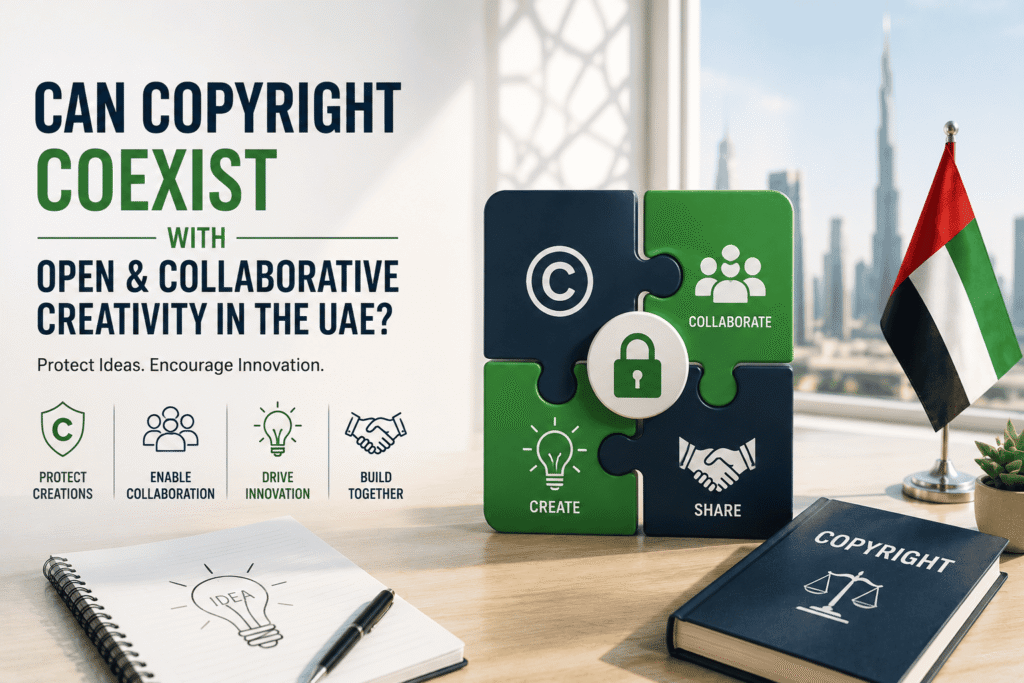
The digital economy has transformed how creative works are developed. Businesses, software developers, artists, researchers, educators and content creators increasingly rely on collaboration to produce innovative ideas and valuable intellectual property. At the same time, copyright remains one of the most important legal tools for protecting original works.
This raises an important question:
Can copyright coexist with open and collaborative creativity? The answer is yes. Modern copyright law, including the legal framework in the United Arab Emirates (UAE), is designed not only to protect creators but also to enable lawful collaboration through licensing, permissions and clearly defined ownership rights.
Whether you are a technology company, marketing agency, software developer, designer or entrepreneur, understanding the relationship between copyright and collaborative creation is essential for protecting your commercial interests while encouraging innovation.
Understanding Copyright in the UAE
Copyright protects original literary, artistic and scientific works once they are created and fixed in a tangible form. Registration is generally not required for copyright to exist, although maintaining evidence of ownership and, where available, formal registration can strengthen enforcement.
The primary legislation governing copyright in the UAE is:
The legislation aligns the UAE with major international copyright standards through treaties such as:
- The Berne Convention
- The WIPO Copyright Treaty
- The TRIPS Agreement
This provides strong protection for both domestic and international creators.
What Is Open and Collaborative Creativity?
Open and collaborative creativity refers to situations where multiple individuals or organisations contribute to developing creative works.
Examples include:
- Open-source software development
- Collaborative research projects
- Shared educational resources
- Creative Commons licensed content
- Joint architectural designs
- Digital artwork created by multiple contributors
- Corporate innovation projects
- Collaborative marketing campaigns
The objective is to encourage innovation through sharing while respecting creators’ rights.
Does Copyright Prevent Collaboration?
Not at all.
One of the biggest misconceptions is that copyright restricts collaboration. In reality, copyright enables collaboration by allowing creators to decide:
- Who may use their work
- How others may modify it
- Whether commercial use is permitted
- Whether attribution is required
- Whether derivative works are allowed
Without copyright protection, creators would have far less control over how their work is used.
How Copyright Supports Open Collaboration
Copyright and open collaboration work together through carefully drafted licences.
These licences establish clear legal permissions while preserving ownership.
Common examples include:
1. Open-Source Software Licences
Developers retain copyright ownership while permitting others to:
- Use the software
- Modify the code
- Distribute improvements
- Build commercial applications (depending on licence terms)
Popular open-source licences include MIT, Apache 2.0 and GNU GPL licences.
2. Creative Commons Licences
Creative Commons licences allow creators to specify how others may use their work.
Permissions may include:
- Attribution requirements
- Non-commercial use only
- No derivative works
- ShareAlike obligations
The copyright owner remains the legal owner throughout.
3. Commercial Collaboration Agreements
Businesses frequently collaborate through contracts covering:
- Joint ownership
- Licensing rights
- Revenue sharing
- Confidential information
- Future commercialisation
- Ownership of improvements
These agreements reduce legal uncertainty and future disputes.
Who Owns Copyright in Collaborative Projects?
Ownership depends on the circumstances.
Possible scenarios include:
Joint Authors
Where multiple individuals contribute original creative input intended to form one work, copyright may be jointly owned.
Employer Ownership
Under UAE law, works created by employees during the course of employment may belong to the employer, subject to employment agreements and applicable legal provisions.
Independent Contractors
Freelancers generally retain copyright unless ownership is assigned through a written agreement.
This is why businesses should never assume they automatically own work created by external consultants.
Common Copyright Risks in Collaborative Projects
Businesses often encounter legal issues because ownership has not been properly documented.
Common risks include:
- Unclear ownership rights
- Multiple contributors claiming authorship
- Use of unlicensed third-party content
- Open-source licence compliance failures
- AI-generated content with uncertain ownership implications
- Copyright infringement claims
- Commercial exploitation without permission
Proper legal documentation significantly reduces these risks.
Best Practices for Businesses Engaging in Collaborative Creativity
Organisations should establish a robust intellectual property strategy from the outset.
Recommended steps include:
- Identify all contributors
- Use written copyright assignment agreements
- Implement confidentiality agreements
- Clearly define ownership before collaboration begins
- Maintain records of creative contributions
- Review open-source licence obligations
- Conduct intellectual property audits
- Register other relevant intellectual property rights where appropriate, such as trade marks and patents
These measures help avoid disputes and strengthen commercial value.
Why Copyright Matters for UAE Businesses
Strong copyright management delivers significant commercial benefits.
These include:
- Protection of valuable business assets
- Increased investor confidence
- Easier licensing opportunities
- Higher business valuation
- Better enforcement against infringement
- Reduced legal disputes
- Greater confidence when expanding internationally
Intellectual property is often among a company’s most valuable commercial assets.
Frequently Asked Questions
Is copyright automatic in the UAE?
Yes. Copyright generally arises automatically once an original work is created and meets the legal requirements under UAE law.
Can several people jointly own copyright?
Yes. Joint ownership is possible when multiple authors contribute original creative expression that together form a single work.
Can I use Creative Commons material commercially?
It depends on the specific licence. Some Creative Commons licences permit commercial use, while others expressly prohibit it.
Does open-source software mean it has no copyright?
No. Open-source software remains protected by copyright. The owner simply grants permissions through an open-source licence.
Protect Your Copyright with Jitendra Intellectual Property, UAE
At Jitendra Intellectual Property (JIP), UAE, we assist businesses, entrepreneurs, creators and innovators with comprehensive intellectual property services tailored to UAE law and international best practices.
Our services include:
- Copyright advisory and protection
- Copyright registration assistance
- Copyright assignment and licensing agreements
- Intellectual property portfolio management
- Trade mark registration
- Patent advisory
- IP enforcement strategies
- Intellectual property due diligence for businesses
Whether you are launching a new product, collaborating on creative projects or safeguarding valuable business assets, our experienced intellectual property professionals can help you navigate the legal landscape with confidence.
Contact Jitendra Intellectual Property today to discuss your copyright and intellectual property requirements and protect your innovations for long-term commercial success.